History
Discover the history of the Opéra de Nice from 1776 to today: from the Maccarani Theatre to its rebuilding by François Aune and its Historical Monument status.
1776
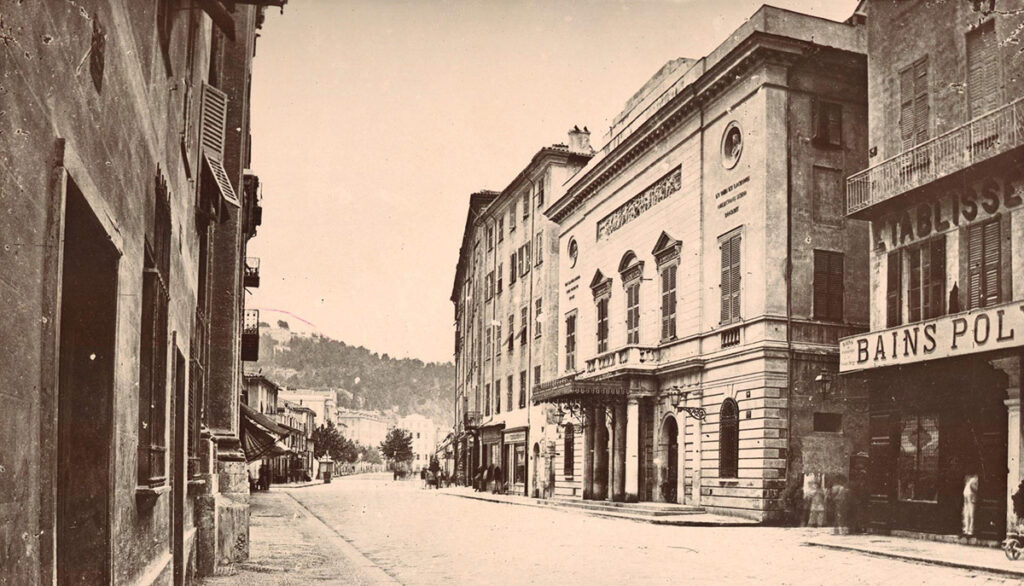
A small wooden theatre
The Marquise Alli-Maccarani obtained from Charles Emmanuel III, King of Sardinia — under whose jurisdiction the County of Nice then fell — permission to convert her former family home into a theatre. Thus, the small Teatro Maccarani, named after its owners, was built in the 18th century on the site of the present-day Opéra.
Fitted out in 1776 and built entirely of wood, its north façade opened onto the city while its south façade faced the ramparts of the Quai du Midi, today known as the Quai des États-Unis.
1826
Works for a new opera house
In 1826, the City of Nice purchased the Theatre on the advice of King Charles Felix and decided to demolish it in order to build a grand opera house in the Italian style on the same site.
It was Brunati, the City Architect, and Perotti, a Turin-based architect, who designed a building with a spacious stalls area, without seating, as was still customary at the time, with four tiers of boxes to seat the wealthy public in comfort, and the grand royal box supported by two gilded caryatids.
The stage was closed by an enormous curtain on which the painter Biscarra depicted, in a giant fresco, the exploits of Nice’s heroine Catherine Ségurane. The back of the stage, facing south as it does today, opened onto a large bay window looking out to sea.
This bay window was bricked up in 1866 and a gigantic sundial was placed at that spot on the Quai du Midi side.
1870
The Opéra became the Théâtre Municipal in 1870.
1881
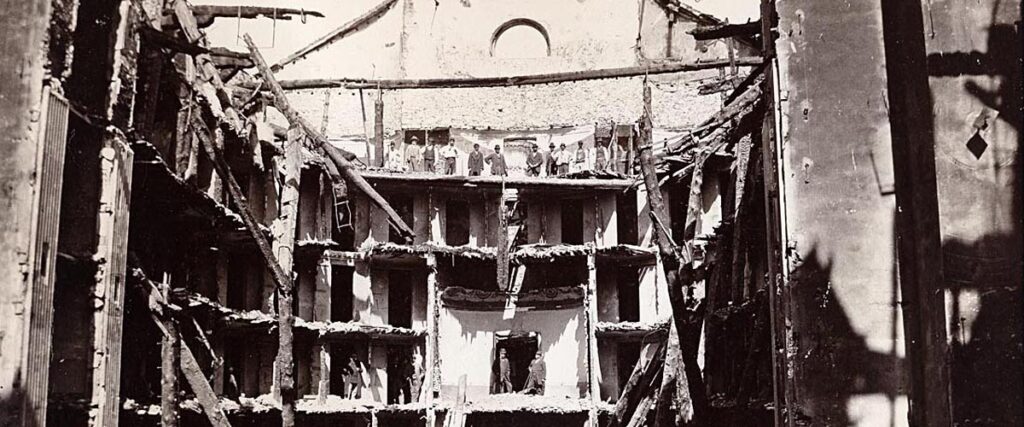
On Wednesday 23 March 1881, during the overture to Lucia di Lammermoor, everything descended into horror within a matter of minutes. A devastating fire, most likely caused by a gas leak at the stage footlights, completely destroyed the theatre and claimed 63 lives.
1882
François Aune’s new theatre
On 7 November 1882, the municipal council decided to rebuild the new theatre on the site of the former one and entrusted François Aune with the plans for the building.
François Aune, born in 1814, was a Nice-born architect who obtained a surveying qualification in Turin before being appointed City Architect. The plans he submitted for the new opera house were approved by Charles Garnier, then Inspector of Civil Buildings.
The exterior construction
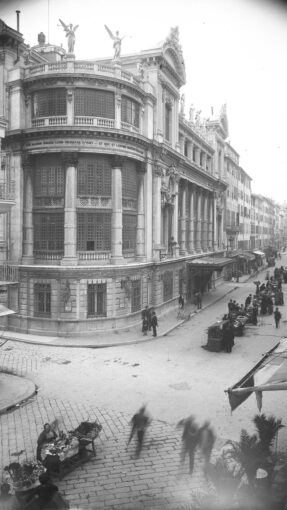
François Aune, a pupil of Gustave Eiffel, built a traditional masonry shell of stone, brick and lime, within which he installed a framework of metal beams.
The interior decoration
The decoration of the auditorium and stage is the result of a compromise between local Nice traditions, the growing influence of Francophiles, and the aesthetic demands of a cosmopolitan audience.
This synthesis of diverse influences was achieved by an architect trained in the Turin school yet tinged, as some critics noted, with Parisian tastes. From the outset, the specifications called for an Italian-style auditorium. The boxes, true intimate private salons, open onto the hall, and together create the effect of a wall pierced by a multitude of openings.
Each patron is free to engage with the performance as they wish, in keeping with a philosophy that favours individual autonomy without compromising collective comfort.
The new theatre was given a magnificent decorative scheme, with a ceiling painted by Emmanuel Costa depicting the Chariot of the Sun.
The sculptures are by Raimondi and represent the Muses: Euterpe (music), Melpomene (tragedy), Thalia (comedy) and Terpsichore (dance).
1902
In 1902, the Théâtre municipal took on the name by which we know it today: the Opéra de Nice.
A landmark venue for opera and symphonic music
After its reopening, operatic life in Nice flourished once more, with premieres such as Marie-Madeleine by Massenet (1903), French premieres of works including Berlioz’s Les Troyens (1891), Ponchielli’s La Gioconda (1886), Tchaikovsky’s Eugene Onegin, Wagner’s Das Rheingold (1902), Shostakovich’s Lady Macbeth of the Mtsensk District, and the world premiere of Henze’s Elegy for Young Lovers (1965).
A long line of divas graced its stage: Nelly Melba, Felia Litvinne, Emma Calvé, Mado Robin, Régine Crespin, Barbara Hendricks, and Montserrat Caballé — whose name is given to the Opéra de Nice’s foyer. Legendary singers have also displayed their vocal talents here: José Luccioni, Cesare Vezzani, Georges Thill, Mario del Monaco, Carlo Bergonzi, Luciano Pavarotti, Franco Corelli, Ruggiero Raimondi, José Carreras, Plácido Domingo, and Jonas Kaufmann.
Montserrat Caballé: the Opéra’s foyer today bears the name of Montserrat Caballé, the great Spanish soprano (1933–2018), who performed many times at the Opéra de Nice.
The Opéra de Nice stage has also hosted prestigious concerts featuring soloists such as pianists Marguerite Long, Arthur Rubinstein, Wilhelm Kempff, and Krystian Zimerman; violinists Jacques Thibaud, Zino Francescatti, and Yehudi Menuhin; and conductors Georges Enesco, Jascha Horenstein, Paul Paray, Igor Markevitch, Eugen Jochum, Wolfgang Sawallisch, and others.
1950-1982
Direction: Ferdinand Aymé
1960
Since the building first opened, a number of elements have changed. The main entrance, which originally led to a grand staircase set within the theatre’s rotunda, was moved to the Rue Saint-François-de-Paule.
Likewise, the proscenium was reduced in size, the great chandelier removed and then reinstated in 1960 (it holds 600 light bulbs), the stalls enlarged, and the paintings in the entrance hall replaced by large mirrors.
1979
The stage tower was rebuilt and modernised in 1979.
The orchestra pit, thanks to its movable platform, allows for a significantly larger number of musicians for concerts and enables the performance of a wider repertoire.
1982-1994
Management: Pierre Médecin
A passionate music enthusiast, he had been an assistant to Wieland Wagner at Bayreuth in the 1950s, before working alongside Georges-François Hirsch when the latter was head of dance at the Opéra Garnier (1979–1981).
Pierre Médecin served as Artistic Adviser to the Opéra de Nice between 1959 and 1966, and became its Artistic Director in 1982. There he produced the complete Wagner Ring cycle and the complete Mozart operas to mark the bicentenary of the composer’s death, as well as a great many works from the standard repertoire and several French premieres, including Janáček’s Kátya Kabanová.