History - period 1776 – 1881
Discover the history of the Opéra de Nice from 1776 to today: from the Maccarani Theatre to its rebuilding by François Aune and its Historical Monument status.
1776
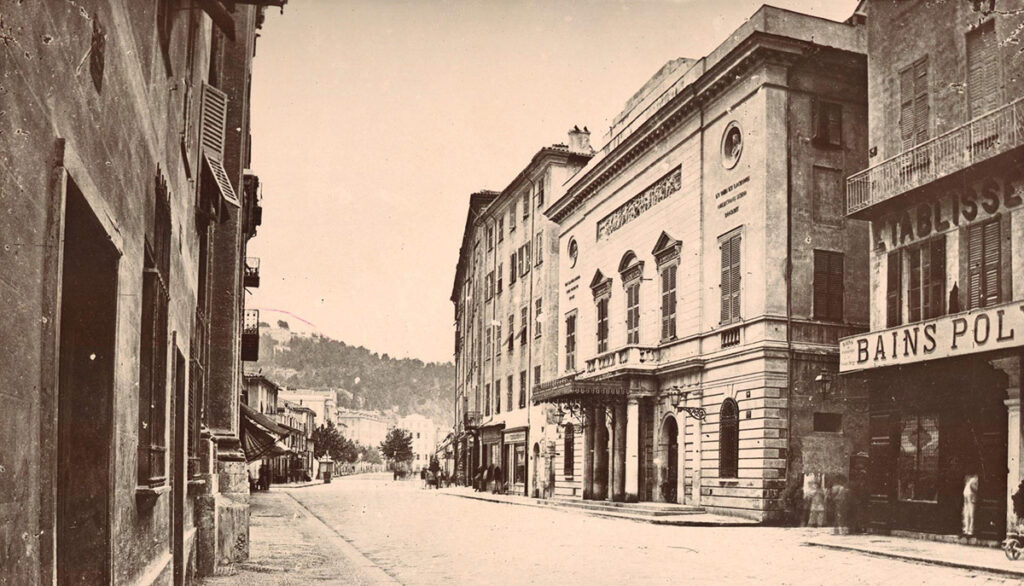
A small wooden theatre
The Marquise Alli-Maccarani obtained from Charles Emmanuel III, King of Sardinia — under whose jurisdiction the County of Nice then fell — permission to convert her former family home into a theatre. Thus, the small Teatro Maccarani, named after its owners, was built in the 18th century on the site of the present-day Opéra.
Fitted out in 1776 and built entirely of wood, its north façade opened onto the city while its south façade faced the ramparts of the Quai du Midi, today known as the Quai des États-Unis.
1826
Works for a new opera house
In 1826, the City of Nice purchased the Theatre on the advice of King Charles Felix and decided to demolish it in order to build a grand opera house in the Italian style on the same site.
It was Brunati, the City Architect, and Perotti, a Turin-based architect, who designed a building with a spacious stalls area, without seating, as was still customary at the time, with four tiers of boxes to seat the wealthy public in comfort, and the grand royal box supported by two gilded caryatids.
The stage was closed by an enormous curtain on which the painter Biscarra depicted, in a giant fresco, the exploits of Nice’s heroine Catherine Ségurane. The back of the stage, facing south as it does today, opened onto a large bay window looking out to sea.
This bay window was bricked up in 1866 and a gigantic sundial was placed at that spot on the Quai du Midi side.
1870
The Opéra became the Théâtre Municipal in 1870.
1881
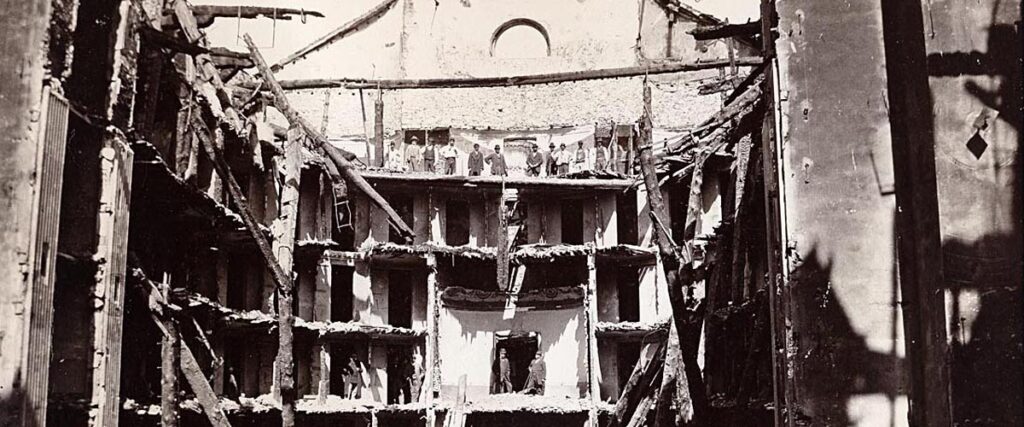
On Wednesday 23 March 1881, during the overture to Lucia di Lammermoor, everything descended into horror within a matter of minutes. A devastating fire, most likely caused by a gas leak at the stage footlights, completely destroyed the theatre and claimed 63 lives.